Looking for more?
You'll find instruction for lots of 3D apps at:
Do you keep hearing the term Caustics bandied about, but aren't sure what is meant by it? Well, you aren't alone. Many programs boast that their renders include "true caustics," but a lot of 3D artists, especially those new to the field, don't really know what is meant by that.
It's really quite simple; and once you know the meaning, you will see why you may be interested in having them available.
According to the American Heritage Dictionary, the fourth definition of "Caustic" is "Of or relating to light emitted from a point source and reflected or refracted from a curved surface."
What are Caustics, anyway? |
||
|
|
|
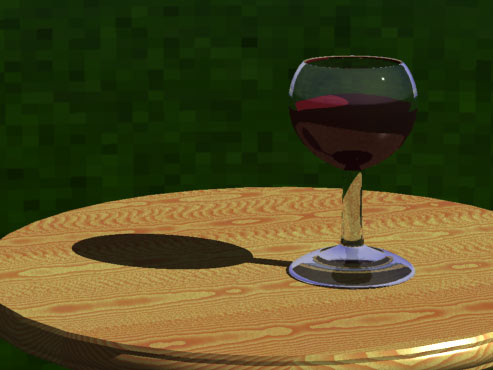
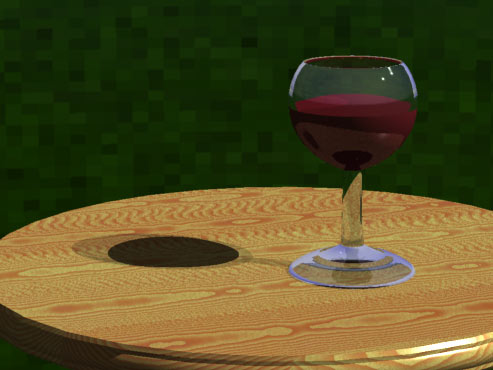
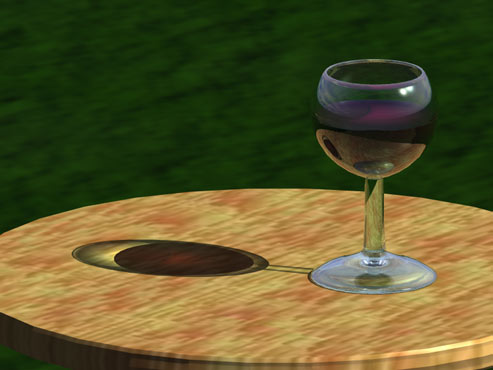
So, if you look at the pictures above, you can see the light refraction in the shadow of the goblet on the right, which has caustics, and not in the one on the left, which was rendered in a program that doesn't have the capability. (You can click on any of the pictures to see a larger image.) Caustics also appear when light is reflected from a curved metallic surface. To see that in real life, place a ring or bracelet in the sunlight on a table. See the pattern of light inside the ring? Those are caustics. Some programs do a better job with them than others. Some don't make any attempt. But it's something you may want to be aware of.
As you can easily see, caustics lend a higher degree of realism to your work. Of course, they also take longer to render. So, as always, you pays your nickle and you takes your choice.